The PR Nobody Read
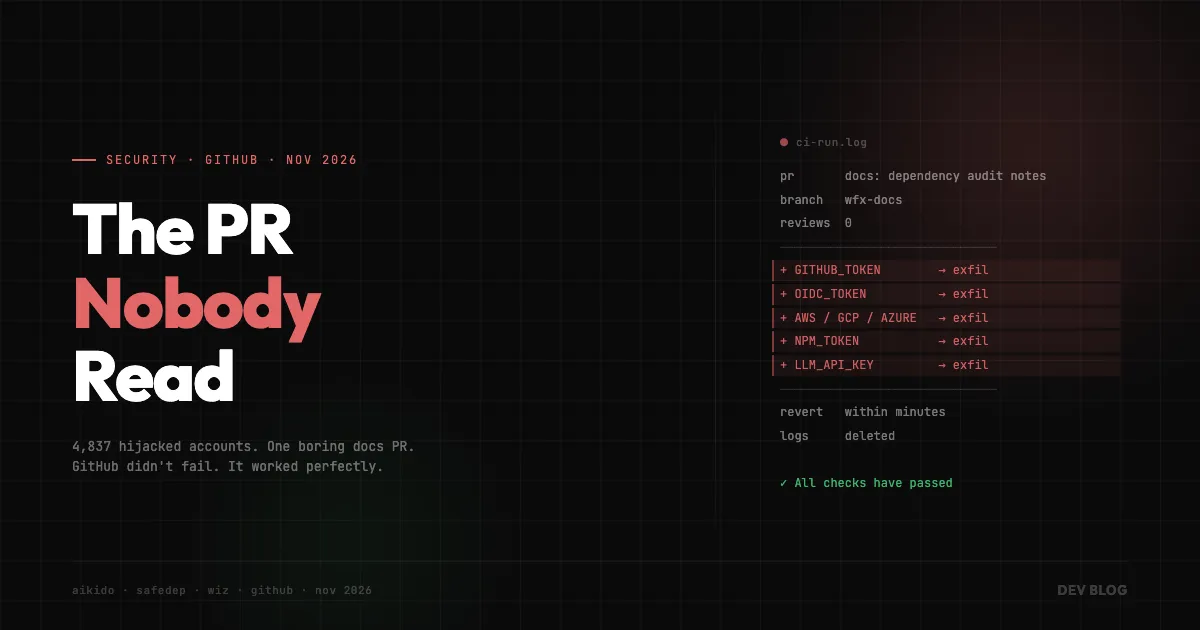
On Tuesday, a pull request called “docs: dependency audit notes” showed up in 61,764 repositories.
That title is the whole trick. Nobody reads a docs PR. It’s the most boring name you can give a branch of changes, and that was the point. The PR wasn’t really a PR. It was a knock on the door. If the account could push the wfx-docs branch, it had write access, and the attacker came back with the real payload: a script dropped into a GitHub Actions workflow (or, in 771 repos, into an npm postinstall hook) that grabbed every secret the runner could see.
Actions secrets. The GITHUB_TOKEN. OIDC tokens. AWS, GCP and Azure credentials. npm and PyPI tokens. SSH keys. And AI service keys, because of course every CI pipeline now has an LLM key sitting in it.
Then the attacker reverted the commit within minutes and deleted the run along with its logs.
4,837 hijacked accounts. Aikido saw the stealer actually run in at least 1,806 repos. SafeDep counted 8,093 repos with malicious commits in less than two days, and they only checked the default branches of public repos.
The number isn’t the part I keep thinking about. This is: accounts hit in October’s GhostAction wave were about 1,000 times more likely to be used again this week. In more than 100 repos, the new stealer went into the same workflow file as October’s stealer, which was still there.
Two thieves sharing one YAML file, and nobody noticed either of them.
So people are asking if we’ll ever get these attacks under control. I’ve been asking it too. My honest answer is no, not in the way the question imagines.
Attacks got cheap. Earlier this year Wiz tracked a campaign called prt-scan where one account was created at 20:59 UTC and opened its first malicious PR two minutes later. It opened 475 PRs in 26 hours. Wiz thinks an LLM wrote the later payloads, because they matched each repo: a Go test file for Go projects, a conftest.py for Python. Their summary is great: “The attack shows automation, not understanding.” The success rate was under 10%. At that speed, 10% is a business model.
And our own AI tools became part of the attack surface. Cline added an AI triage bot to its repo, gave it Bash, and put the issue title straight into the prompt. Someone wrote an issue title that looked like a tool error. Claude ran the payload, the payload poisoned the Actions cache, and the nightly release job picked up the poison and leaked the publishing tokens. Cline fixed the workflow and rotated its tokens. It also revoked the wrong npm token. A week later, someone used the one that was left to publish [email protected]. It stayed live for about eight hours.
That’s the pattern. The attack runs at machine speed. The cleanup runs at human speed, from a spreadsheet, at 2 AM, and it misses one token. I wrote about this from the other side in The Agent Has Root Access: once a thing can run commands, its permissions are your architecture.
Here’s the turn, though. We never “won” against spam either. Spam just got boring. The fix wasn’t a smarter user. It was defaults that moved to the provider.
Look at who prt-scan didn’t get. Sentry, NixOS and IPFS were targets, and the attack bounced off. Not because they had some AI defense. They had contributor approval gates and path-based trigger conditions. Two settings. Boring config beat AI-written payloads.
The same goes for the thing everyone steals: long-lived secrets. A token that lives for months is worth stealing. A token that lives for 10 minutes and works for one job is worth a lot less. Cline moved npm publishing to OIDC after its incident, and that’s the right direction. It’s not magic, though. This week’s stealer also trades OIDC tokens for cloud sessions, and on Azure it adds its own federated credentials so it can sign in again after you rotate. Short-lived only helps if it’s also narrow.
So, no, we won’t control these attacks. We can make each stolen credential worth less and expire sooner. That’s a less exciting goal, and it’s the one that works.
Now, GitHub. My first reaction to this story was “GitHub, again?” It feels like GitHub is always down. And honestly, it kind of is. On August 17 it was out for 7 hours and 47 minutes. In the postmortem, the CTO wrote that monthly commits went from 1.4 billion to 2.9 billion since April, and that they added more than 3 million CPU cores and 120 petabytes of storage to keep up. He also wrote: “If you were trying to ship software that day, we let you down.” A good part of that load is us, and the agents we leave running all night.
But GitHub wasn’t hacked here. There was no vulnerability. The attacker logged in with real credentials and used GitHub exactly as designed. GitHub worked perfectly. It ran the stealer on time, on every push.
The outage costs you an afternoon. The uptime is the scary part.
So I split the trust question in two. Do I trust GitHub as the place where my code lives and my CI runs? Mostly, yes, with a plan for the bad afternoon. Do I trust it as my security boundary? No, and that was never its job. A workflow that gives every secret to every branch is my config, not theirs. Aikido checked the test PRs that came in through collaborator access, and 92% were still open. Those are repos that people have write access to, and nobody is watching them.
The attack didn’t need GitHub to fail. It only needed our secrets to sit where any pushed commit could read them. That part is ours to fix.