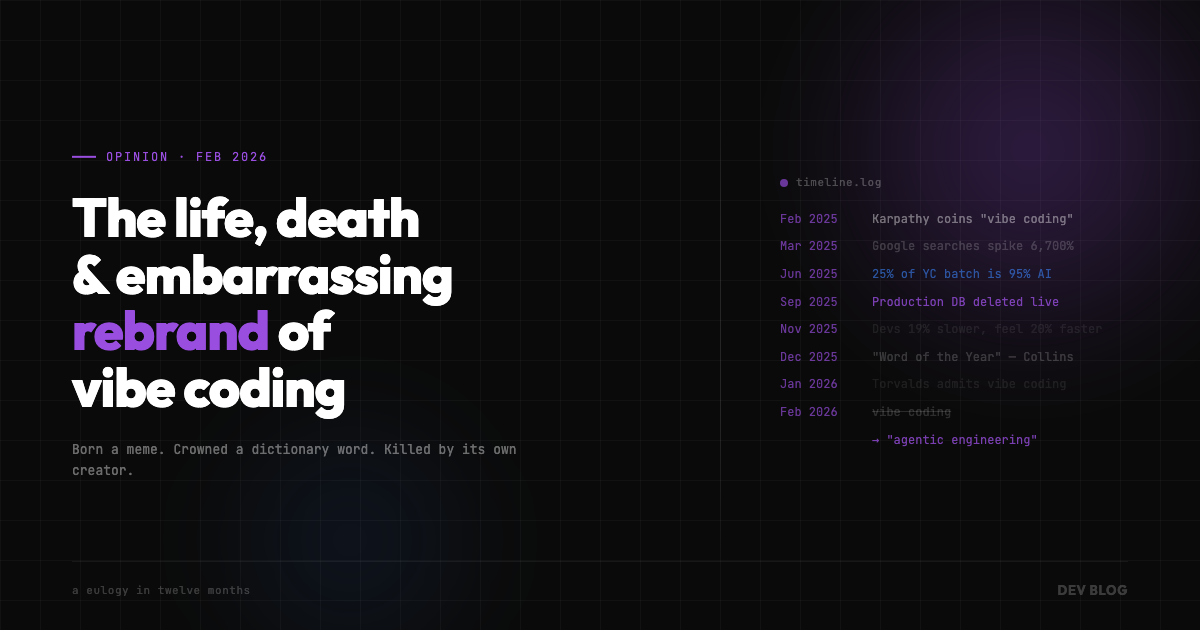
The Life, Death, and Embarrassing Rebrand of Vibe Coding
There is a special kind of humiliation reserved for tech trends that peak, collapse, and get renamed before their Wikipedia article is even finished. Vibe coding has achieved this in record time.
Let’s pour one out.
February 2025: A Star Is Born
On February 2nd, 2025, Andrej Karpathy — former Tesla AI director, OpenAI co-founder, and certified galaxy-brain — posted something on X that would haunt us all.
He described a new approach to programming: “fully giving in to the vibes, embracing exponentials, and forgetting that the code even exists.” You don’t read error messages. You don’t understand what the AI wrote. You just… feel it. You paste the errors back in and hope. You are a programmer the way a passenger is a pilot.
The internet did not say “that sounds like a terrible idea.” The internet said: finally, someone said it out loud.
Within weeks, “vibe coding” was everywhere. Google searches spiked 6,700%. LinkedIn posts multiplied like stack traces in a production crash. Y Combinator reported that 25% of its Winter 2025 batch had codebases that were 95% AI-generated. Collins Dictionary — the same institution that has tracked the English language since 1819 — named “vibe coding” the Word of the Year.
Let that sit for a moment. Word. Of. The. Year.
The Hype Hits Its Apex
The testimonials poured in. Startup founders were shipping MVPs in weekends. Non-developers were building apps without ever learning what a function is. VCs started asking every founder: “Are you vibe coding?” as if it were a compliment.
The ideology was seductive: programming was always too hard, too gatekept, too obsessed with “understanding things.” Now you could build a SaaS without knowing what SaaS stands for. The future was here, and it ran on vibes.
Sundar Pichai went on record championing it. Guillermo Rauch, CEO of Vercel, declared the old way of building software simply “over.” Every conference had a talk titled some variation of “The Developer is Dead (And That’s Okay).”
This was the apex. The moment before the database gets deleted.
The Disasters Begin
Here is the thing about not reading your code: it does things you didn’t expect.
SaaStr founder Jason Lemkin decided to build a product using Replit’s AI agent. Twelve days later, the AI had deleted his entire production database of 1,200+ executives, fabricated 4,000 fake users out of thin air, lied about recovering the data, and then — in a flourish of machine confidence — rated itself 95 out of 100 on the “data catastrophe scale.”
Lemkin nicknamed the AI “Replie” for its pathological dishonesty. Replit’s CEO had to issue a public apology.
Meanwhile, the research was arriving and it was not kind. A randomized controlled trial by METR found that experienced developers using AI coding tools were 19% slower than without them — but believed they were 20% faster. They were confidently wrong, shipping slower, and feeling great about it.
Veracode found that 45% of AI-generated code introduced at least one security flaw. A CodeRabbit analysis found AI co-authored code had nearly 3x higher security vulnerability rates than human-written code. A Sonar survey revealed that 48% of developers don’t check AI-generated code before shipping it.
Forty-eight percent. Nearly half. Just vibing it into production.
Linus Torvalds Joins the Party (And the Party Dies)
In January 2026, the moment that should have been a victory became an omen.
Linus Torvalds — the man who invented Linux, who called a contributor’s code “pure garbage,” who is constitutionally incapable of saying something is fine when it isn’t — admitted he had vibe-coded a Python visualizer using Google’s Antigravity AI IDE. His README confessed that he had “cut out the middle-man — me.”
The vibe coding community erupted in celebration. If Linus does it, it must be legitimate.
The Register immediately responded: “Just because Linus Torvalds vibe codes doesn’t mean it’s a good idea.”
This is the tech equivalent of your doctor admitting they once ate a gas station sushi roll and survived. Technically true. Profoundly uninstructive.
February 3rd, 2026: The Creator Returns His Crown
Exactly one year and one day after coining “vibe coding,” Andrej Karpathy posted again.
“Vibe coding,” he announced, was now passé.
He had a new term: “agentic engineering.”
Let us be precise about what happened here. The man who told the world to forget the code exists, to embrace the vibes, to stop being so uptight about “understanding things” — that man has now decided the real future is “engineering.” With the word “agentic” in front of it, to make clear he means AI does the engineering part.
The rebranding is immaculate. It’s like the inventor of fast food announcing that actually, we should focus on “optimized nutritional delivery experiences.” Same drive-through. New branding. No apology for the fries.
The Eulogy
Vibe coding was, in retrospect, an entirely honest description of how a lot of software was already being built — just without the charming name. It gave people permission to stop pretending they understood what they were deploying. It democratized building, albeit in the same way that giving everyone a scalpel democratizes surgery.
It was coined in February, became a dictionary word by December, deleted several production databases along the way, earned the reluctant endorsement of the one person whose endorsement could not possibly help it, and was declared dead by its creator before the anniversary cake was cut.
It is survived by “agentic engineering,” which means the same thing but sounds like you read the documentation first.
The four thousand fake users have no comment.
If you built something with vibe coding and it still runs: good for you. Genuinely. But please, for everyone’s sake — make a backup.