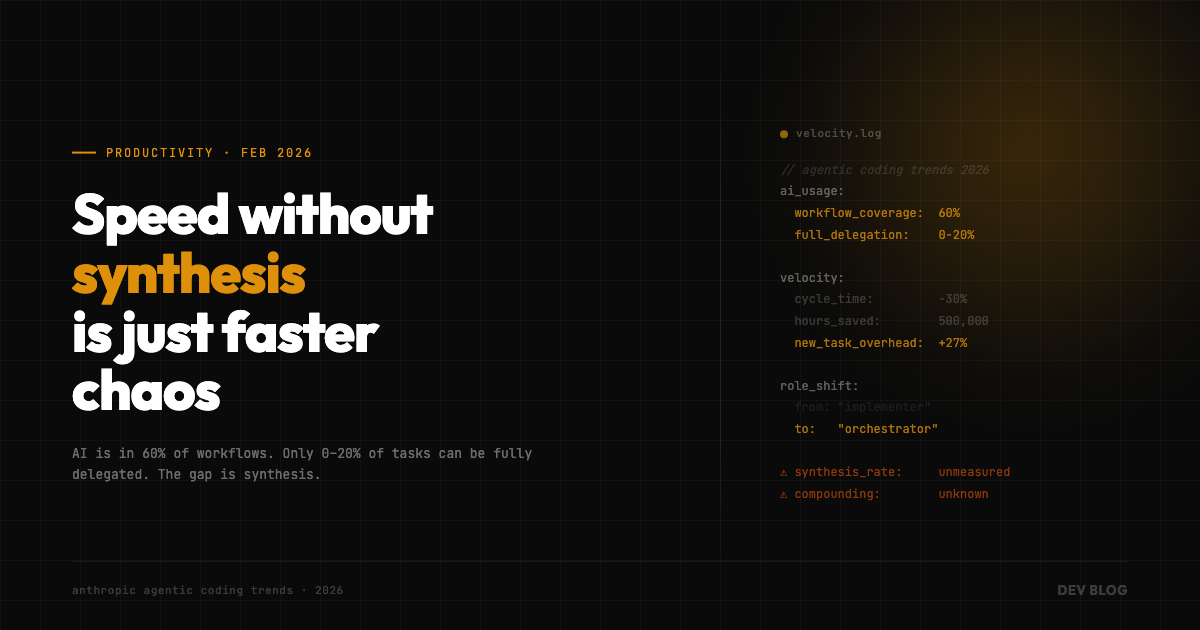
Speed Without Synthesis Is Just Faster Chaos
There’s a stat in Anthropic’s 2026 Agentic Coding Trends Report that I keep thinking about.
Developers now use AI in roughly 60% of their work. But they report being able to “fully delegate” only 0–20% of tasks.
Read that again. AI is everywhere in the workflow. And yet humans are still deeply involved in almost everything. Not because the tools aren’t good enough — because the work actually requires it.
That tension is worth sitting with.
The Numbers Are Real
The productivity numbers are real. TELUS shipped engineering code 30% faster and saved over 500,000 hours. A project one CTO estimated at 4–8 months got done in two weeks. Rakuten had an agent autonomously implement a complex feature in a 12.5-million-line codebase — in seven hours, with 99.9% accuracy.
Execution has genuinely gotten that cheap. Building the thing is now often faster than debating whether to build it. The old “research → align → build” sequence doesn’t always make sense when you can skip straight to finding out.
So teams ship. Then ship again. Then again. The loop is tight and the feedback is immediate and it feels like learning.
The Expanding Surface Area
But here’s what the report quietly surfaces: about 27% of AI-assisted work consists of tasks that wouldn’t have been done otherwise. Nice-to-have dashboards. Minor papercuts. Exploratory experiments that were never cost-effective before.
That’s genuinely great. But it also means the surface area of “stuff we built” is expanding faster than ever — and most teams have no system for figuring out what any of it actually means.
From Implementer to Orchestrator
The report describes the engineer’s role shifting from implementer to orchestrator. You’re no longer writing every line — you’re decomposing problems, directing agents, evaluating output, providing the “taste” and organizational context the AI can’t have.
One internal quote from Anthropic’s research stuck with me:
“I’m primarily using AI in cases where I know what the answer should be or should look like. I developed that ability by doing software engineering ‘the hard way.’”
That’s the thing nobody says out loud in the speed conversation. The reason you can delegate a task is because you understand it well enough to verify the result. The intuition that lets you “sniff-check” the output — that came from slower, harder work done before the tools got this good.
Data Is Not Understanding
Fast cycles produce data. They don’t automatically produce understanding. And if you never stop to synthesize what the data is telling you, you’re not compounding your learning — you’re just running faster on a treadmill.
The teams that are actually pulling ahead aren’t just shipping more. They’re building what the report calls “intelligent collaboration” — systems where AI handles routine verification and humans step in specifically at the moments that require judgment. Not reviewing everything. Not delegating everything. Knowing which is which.
That distinction requires synthesis. It requires someone to stop after a cycle and ask: what did we learn? What does this change? Where does human judgment actually matter here, and where are we wasting it on things the agent could handle?
Most teams skip that conversation. The next thing is already queued up. Skipping it feels like efficiency.
It isn’t. It’s just faster accumulation of things you built without quite knowing why they worked.
The Real Gap
The report frames 2026 as a moment when “the gap between early adopters and late movers is widening.” I think that gap has less to do with who ships fastest and more to do with who synthesizes best.
Execution is table stakes now. Everyone has access to the same tools. The edge is in what you do with what you learn — how quickly you turn a pile of shipped experiments into a sharper mental model of what you’re actually building and why.
Speed without synthesis is just faster chaos.
The teams that figure out how to slow down just enough to think — while keeping the execution velocity high — are the ones that are actually going to compound.