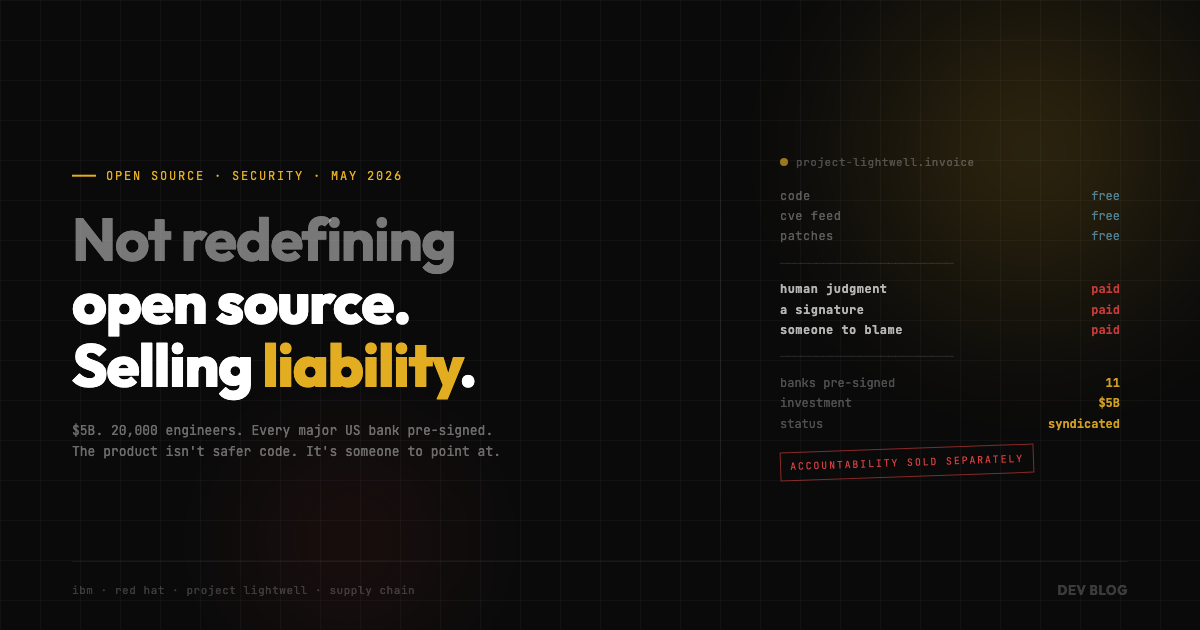
IBM and Red Hat Aren't Redefining Open Source. They're Selling Liability.
The press release uses the phrase “redefining the future of open source.” Sure.
What’s actually happening is more interesting. IBM and Red Hat are spinning up a $5 billion vulnerability triage operation called Project Lightwell, staffing it with 20,000 engineers and a wall of AI. They showed up on day one with every major bank in America already on the customer list.
Bank of America. BNY. Citi. Goldman Sachs. JPMorgan. Mastercard. Morgan Stanley. RBC. State Street. Visa. Wells Fargo.
That isn’t a launch announcement. That’s a syndicate. When that many banks turn up at the same press conference, the meetings happened months ago and someone in compliance was very, very tired.
Strip the marketing layer off Project Lightwell and the pitch gets simple: open source code runs your bank, you have no real idea what’s in it, the last few years of supply chain attacks have given your CISO a permanent eye twitch, and you would now like to pay someone to be responsible for it.
That’s the gap IBM is selling into. They’re building a clearinghouse that finds vulnerabilities, fixes them, ships hardened patches, and puts a corporate signature on the result. The signature is the actual product. You’re not buying secure software. You’re buying someone to point at when things go wrong.
This is the Red Hat business model, scaled to the AI era. The code is still free. The accountability isn’t.
The number I keep coming back to is twenty thousand. Twenty thousand engineers, augmented by AI. Not replaced. Not “automated by agents.” The release explicitly frames technical expertise as a competitive advantage rather than a cost to eliminate.
While half the industry is announcing layoffs and gesturing vaguely at productivity gains, IBM is announcing a hiring plan that says the quiet part out loud. Reading vulnerabilities. Judging severity. Getting patches accepted upstream. That kind of work is exactly what AI is bad at without humans in the loop. You can’t ship a fix to glibc using an autonomous agent. You need a person who knows how to argue with maintainers at 11pm on a Wednesday.
The pitch isn’t really about AI. AI is the lubricant. The actual product is human judgment, sold by the hour, dressed up in subscription pricing.
The bigger question, the one the press release doesn’t touch, is what this does to the upstream projects. The maintainers who write the code the banks depend on, who get paid in GitHub sponsorships and burnout. IBM is about to make billions sitting on top of their labor. Will any of it flow back?
The release mentions “upstream maintenance collaboration,” which is the kind of phrase you write when you want to sound supportive without committing to a dollar figure.
If even a small percentage of that $5 billion ended up funding the maintainers of the projects this whole thing depends on, that would be a real shift. If it doesn’t, this is just another extraction layer dressed up in open source language.
Five billion buys a lot of patches. It also buys the right to define what “secured open source” means for the next decade.
That’s the actual deal.